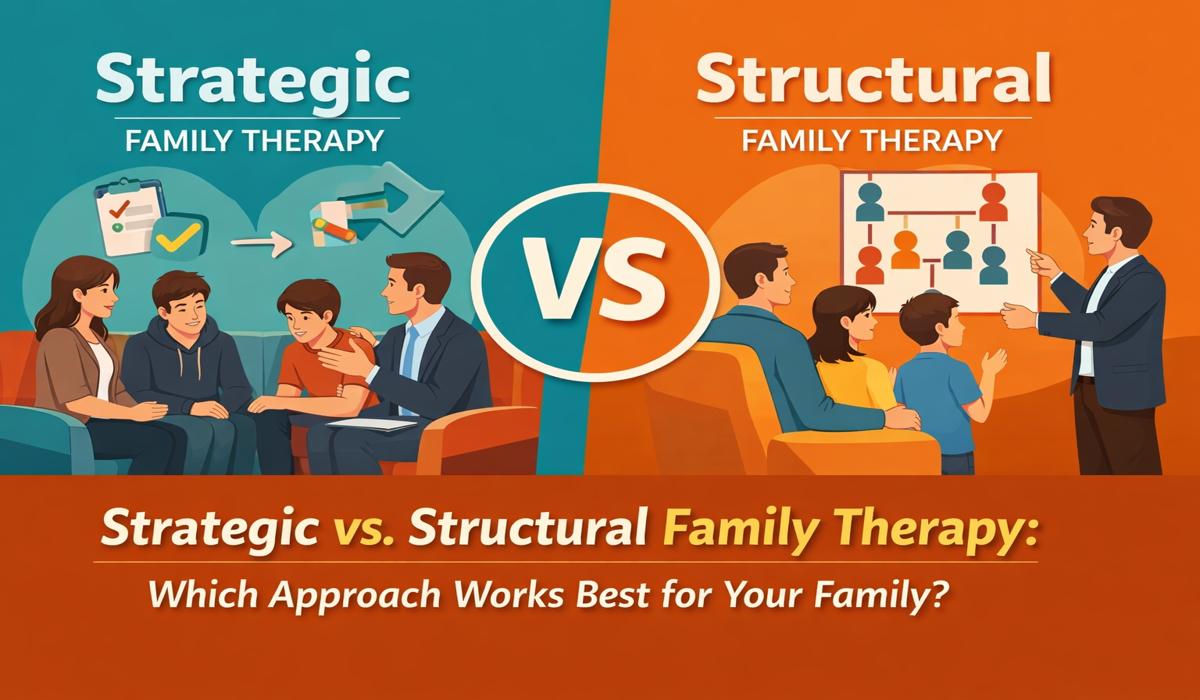
Strategic vs. Structural Family Therapy: Which Approach Works Best for Your Family?
When families begin searching for help, they often discover that not all therapy approaches are the same. Two of the most widely practiced and researched models are Strategic Family Therapy and Structural Family Therapy. While both focus on improving communication and resolving conflict within the family system, they use different methods and philosophies to create change. Understanding these differences can help you choose the right path for your family’s unique situation.
 Family therapy is not about assigning blame. It is about recognizing patterns, strengthening relationships, and helping each member feel heard and supported. At Aeon Counseling and Consulting, we often guide families through this decision by carefully assessing their goals, challenges, and relational dynamics before recommending a therapeutic direction.
What Is Strategic Family Therapy
Strategic Family Therapy is a short term, goal oriented approach that focuses on solving specific problems within the family. Rather than deeply analyzing the past, this model concentrates on present interactions and behavioral patterns that maintain conflict. The therapist takes an active role, often assigning tasks or interventions designed to interrupt unhealthy cycles.
This approach was influenced by pioneers such as Jay Haley and Cloe Madanes. It is especially effective for families dealing with adolescent behavioral problems, defiance, substance misuse, or recurring power struggles. The core belief is that problems persist because of repetitive interaction patterns. By strategically changing those patterns, families can experience rapid improvement.
Strategic therapy tends to be structured and direct. Sessions may include homework assignments, reframing techniques, or specific communication exercises designed to shift dynamics quickly. Families who appreciate clear direction and solution focused strategies often benefit from this model.
What Is Structural Family Therapy
Structural Family Therapy, developed by Salvador Minuchin, focuses on the organization and hierarchy within a family. It examines boundaries, roles, alliances, and subsystems to determine how the family structure may be contributing to stress or dysfunction.
In this approach, the therapist works to reorganize the family system so that it functions more effectively. For example, if a child holds too much authority or parents are not united in leadership, therapy will address these structural imbalances. The goal is to create clear boundaries, strengthen parental authority, and improve overall cohesion.
Structural therapy is particularly helpful in blended families, families experiencing divorce, or households where generational boundaries are unclear. It looks at the bigger relational picture rather than focusing solely on one presenting issue.
Key Differences Between Strategic and Structural Family Therapy
Below is a comparison to help clarify how these approaches differ and when each may be appropriate.
| Area of Focus | Strategic Family Therapy | Structural Family Therapy |
|---|---|---|
| Main Goal | Resolve specific problems quickly | Reorganize family structure and roles |
| Therapist Role | Directive and task oriented | Active but focused on reshaping interactions |
| Time Frame | Often short term | May require longer engagement |
| Best For | Behavioral issues, repeated conflicts | Boundary problems, hierarchy imbalance |
| Focus on Past | Minimal | Explores patterns across time |
Both approaches recognize that families operate as systems, meaning one person’s behavior affects everyone else. However, the path to change differs in strategy and depth.
Which Approach Works Best for Your Family
The answer depends on your family’s needs, goals, and the complexity of the situation. If your family is dealing with a clearly defined issue such as a teenager refusing school or constant sibling conflict, Strategic Family Therapy may provide efficient, targeted solutions.
If your challenges involve unclear parental authority, emotional distance, blended family transitions, or long standing relational tension, Structural Family Therapy may offer deeper transformation by restructuring interaction patterns.
In many cases, experienced therapists integrate elements of both models. At Aeon Counseling and Consulting, treatment plans are personalized rather than one size fits all. After a thorough assessment, we may combine strategic interventions with structural realignment techniques to ensure sustainable growth.
Families seeking family counseling services often benefit from an initial consultation where goals are clarified and the most appropriate framework is discussed. Whether you are looking for help with parenting challenges, communication breakdown, or major life transitions, the right therapeutic approach can make a significant difference.
Benefits of Family Therapy Regardless of Approach
While Strategic and Structural models differ, both offer meaningful benefits.
Improved communication is often the first positive change families notice. Members begin expressing thoughts and feelings more openly without fear of judgment. Therapy also strengthens emotional connection by creating a safe space for honest dialogue.
Conflict resolution skills improve as families learn healthier ways to manage disagreements. Instead of escalating arguments, members practice active listening and respectful problem solving.
Parental confidence increases when boundaries are clarified and leadership roles are strengthened. Children and adolescents often feel more secure when family expectations are consistent and predictable.
Most importantly, therapy fosters empathy. Each person gains insight into how their actions impact others, which promotes accountability and compassion.
Families interested in professional support can explore our family therapy services to learn more about available treatment options and scheduling.
When to Seek Professional Support
Many families wait until problems feel overwhelming before reaching out. However, early intervention often leads to better outcomes. Signs that your family may benefit from therapy include persistent communication breakdown, emotional withdrawal, frequent conflict, behavioral concerns in children, or difficulty adjusting to life changes such as relocation or divorce.
At Aeon Counseling and Consulting, our clinicians provide compassionate, evidence based care tailored to each family’s cultural background and individual needs. We also offer related services such as individual counseling and couples therapy when additional support is beneficial.
Seeking help is not a sign of failure. It is a proactive step toward healthier relationships and long term stability.
Frequently Asked Questions
What is the main difference between Strategic and Structural Family Therapy?
Strategic therapy focuses on solving a specific problem through targeted interventions, while Structural therapy aims to reorganize the family system by adjusting boundaries, roles, and hierarchies.
Is one approach more effective than the other?
Neither approach is universally better. Effectiveness depends on the nature of the family’s challenges, their goals, and their readiness for change. A trained therapist can recommend the most suitable model after assessment.
How long does family therapy usually last?
Strategic Family Therapy may be shorter in duration because it targets specific issues. Structural Family Therapy may take longer as it works to reshape deeper relational patterns. The timeline varies for each family.
Can both approaches be combined?
Yes, many therapists integrate techniques from both models to address immediate concerns while also improving overall family structure for lasting change.
References
Minuchin S. Families and Family Therapy. Harvard University Press.
Haley J. Problem Solving Therapy. Jossey Bass.
American Association for Marriage and Family Therapy. Family Therapy Overview.
Aeon Counseling and Consulting. Family Therapy Services Page.