Strategic vs. Structural Family Therapy: Which Approach Works Best for Your Family?
When families start looking for help, one of the first things they discover is that therapy is not one-size-fits-all. Two of the most widely practiced and researched models in family therapy are Strategic Family Therapy and Structural Family Therapy. Both focus on improving communication and resolving conflict within the family system. The methods they use and the philosophical frameworks they operate from are where the differences begin. Understanding those differences is not just academic. It is the first step toward choosing the right path for your family’s specific situation, and it is a decision worth making with clarity rather than guesswork.
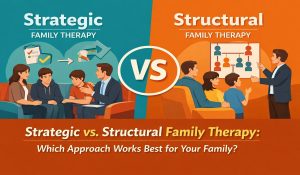 Family therapy is not about identifying who is at fault. It is about understanding the patterns that have developed over time and strengthening the relationships that hold the family together. Creating conditions where every member feels genuinely heard is where that work begins. At Aeon Counseling and Consulting, that process starts with a real assessment of what your family is actually carrying, not a predetermined recommendation based on a checklist. The right approach depends on your specific situation, and getting that right matters more than moving fast.
What Is Strategic Family Therapy?
Strategic Family Therapy is a short-term, goal-oriented approach built around one premise: the problem is not the people, it is the pattern. Rather than spending significant time analyzing the past, this model focuses on the present interactions and behavioral cycles that are actively keeping a family stuck right now. The therapist takes a directive role, designing specific tasks and interventions intended to interrupt those cycles before they run again. Developed by pioneers including Jay Haley and Cloe Madanes, Strategic Family Therapy operates from one core clinical belief.
Problems persist because of repetitive interaction patterns, and changing those patterns is the most direct route to meaningful improvement. That makes it particularly effective for families dealing with adolescent behavioral problems, defiance, substance misuse, or recurring power struggles. These are the situations where the same argument keeps happening with the same outcome and nobody inside the family can figure out how to stop it. Strategic Family Therapy is designed to interrupt that cycle directly.
What Is Structural Family Therapy?
Structural Family Therapy, developed by Salvador Minuchin, focuses on the organization and hierarchy within a family. It examines boundaries, roles, alliances, and subsystems to determine how the family structure may be contributing to stress or dysfunction.
In this approach, the therapist works to reorganize the family system so that it functions more effectively. For example, if a child holds too much authority or parents are not united in leadership, therapy will address these structural imbalances. The goal is to create clear boundaries, strengthen parental authority, and improve overall cohesion.
Structural therapy is particularly helpful in blended families, families experiencing divorce, or households where generational boundaries are unclear. It looks at the bigger relational picture rather than focusing solely on one presenting issue.
Strategic Therapy Is Built for Families Who Want to Stop Repeating Themselves
Sessions are structured and purposeful by design. Homework assignments, reframing techniques, and specific communication exercises are not filler. They are precision tools aimed at disrupting the exact patterns that brought the family in. Families who get the most out of this model tend to be the ones who are done sitting with the problem and ready to move toward a solution. If your family wants clear direction, defined goals, and a clinical approach that respects your time and moves with intention, Strategic Family Therapy is worth serious consideration.
What Is Structural Family Therapy?
Structural Family Therapy, developed by Salvador Minuchin, starts from a different premise entirely. The problem is not always what it looks like on the surface. Sometimes the real issue is how the family is organized. The boundaries that have become unclear, the roles that have shifted out of alignment, the alliances that have formed in ways that undermine the whole system are where the actual work lives. Structure is the focus, not the symptom.
When a family’s structure is working the way it should, problems are easier to navigate. Structural imbalances that go unaddressed tend to generate problems regardless of how hard individual family members are trying. A child who holds too much authority, parents who are not unified in their approach, or generational boundaries that have become blurred are all structural issues. Addressing them symptom by symptom misses the point. Structural Family Therapy works to reorganize the underlying dynamic instead.
When the Issue Is How the Family Is Built
This approach is particularly useful for blended families, families navigating divorce, or households where the hierarchy has quietly shifted over time in ways nobody fully noticed until things started breaking down. It looks at the broader relational picture rather than zeroing in on one presenting issue, which makes it the right choice for families whose challenges keep changing shape but never quite go away.
Key Differences Between Strategic and Structural Family Therapy
Both approaches recognize that families operate as systems, meaning one person’s behavior affects everyone else in the unit. Where they differ is in what they are actually trying to change and how they go about it. Strategic Family Therapy goes after the problem directly. The family therapist is directive, the timeline is intentionally short, and the focus stays on what is happening now rather than how the family got here. If the problem is clear and the goal is specific, this is the model that moves.
Structural Family Therapy goes after the system the problem lives inside. The work is slower by design because it is reshaping something deeper, the way the family is organized, the roles that have calcified, the boundaries that stopped functioning. When the challenges feel less like a single problem and more like a pattern that keeps showing up in different clothes, this is the model worth considering.
In practice, the most effective family therapy often draws from both. A family therapist in Lynn, MA who is experienced in both models will not force your family into one framework. They will use whatever combination of approaches actually fits what your family is carrying.
| Area of Focus | Strategic Family Therapy | Structural Family Therapy |
|---|---|---|
| Main Goal | Resolve specific problems quickly | Reorganize family structure and roles |
| Therapist Role | Directive and task oriented | Active but focused on reshaping interactions |
| Time Frame | Often short term | May require longer engagement |
| Best For | Behavioral issues, repeated conflicts | Boundary problems, hierarchy imbalance |
| Focus on Past | Minimal | Explores patterns across time |
Both approaches recognize that families operate as systems, meaning one person’s behavior affects everyone else. However, the path to change differs in strategy and depth.
 Which Approach Works Best for Your Family?
 Which Approach Works Best for Your Family?
The honest answer is that it depends, and any clinician who tells you otherwise before meeting your family is oversimplifying. The right approach depends on what your family is dealing with, how long it has been going on, and what you are hoping to walk away with. If your family is navigating a clearly defined issue, Strategic Family Therapy may offer the most efficient and targeted path forward.
A teenager who has stopped going to school, constant sibling conflict that has escalated beyond normal friction, or a specific behavioral pattern that is affecting daily functioning all fit this category. The problem is clear, the goal is specific, and this model is built to move. The directiveness of the model is an asset when the problem is clear and the goal is equally clear.
Why Aeon Rarely Commits to Just One Model
If your challenges feel more systemic, Structural Family Therapy may offer deeper and more lasting transformation. Unclear parental authority, emotional distance that has been building for years, a blended family still finding its footing, or long-standing relational tension that predates any single event all point in this direction. This model addresses the underlying architecture of how your family operates rather than just the presenting concern. When the issue is structural, the solution needs to be structural too. In practice, experienced therapists often integrate elements of both.
At Aeon Counseling and Consulting, treatment is personalized rather than predetermined. After a thorough assessment of your family’s goals, history, and relational dynamics, we may combine strategic interventions with structural realignment. The goal is to address both the immediate concern and the systemic conditions that allowed it to develop. Families who engage in family therapy in Lynn, MA with that kind of integrated approach often find that the changes they make hold longer and reach further than they expected going in.
Benefits of Family Therapy Regardless of Approach
Whatever model a family engages with, the benefits of doing this work together tend to be significant and wide-reaching.
What Families Notice Before Anything Else
Improved communication is usually the first shift families notice. Members begin expressing thoughts and feelings more openly, not because the therapist told them to, but because the therapeutic environment created enough safety for that to happen naturally. That shift in communication tends to ripple outward into daily life in ways that outlast the therapy itself.
Conflict Does Not Disappear. It Changes Shape.
Conflict resolution skills develop as families learn to address disagreements before they escalate. The arguments that used to end in doors slamming or weeks of silence start to look different when everyone in the room has better tools for staying in the conversation rather than abandoning it.
When Parents Feel Steadier, Kids Do Too.
Parental confidence increases when roles are clarified and leadership within the family becomes more consistent. Children and adolescents tend to feel more secure when expectations are clear and predictable, even when they push against them.
The Shift That Follows Families Out of the Room
Empathy deepens across the board. When every person in a family gains genuine insight into how their behavior affects the people around them, accountability becomes less about blame and more about understanding. That shift is one of the most durable outcomes of family therapy, and it tends to show up in every relationship the family members carry outside the therapy room as well.
When to Seek Professional Support
Most families wait longer than they should before reaching out. By the time they make the call, the patterns they are dealing with have usually been running long enough to feel permanent. They are not. But earlier intervention almost always produces better outcomes than waiting until the situation feels completely unmanageable. Signs that your family may benefit from family therapy in Lynn, MA include persistent communication breakdown where the same conversations keep ending the same way.
Emotional withdrawal from one or more family members is another signal worth taking seriously. Frequent conflict that no one inside the family has been able to de-escalate, behavioral concerns in children or adolescents, or difficulty adjusting to major life changes like relocation, divorce, or the addition of a new family member all point in the same direction. If any of those feel familiar, that recognition is worth acting on.
At Aeon Counseling and Consulting, our clinicians provide compassionate, evidence-based care tailored to each family’s cultural background and individual needs. Reaching out is not an admission that the family has failed. It is a decision to stop white-knuckling something that deserves real support.
Is Family Therapy Right for Your Family?
Understanding how these approaches differ is one thing. Knowing which one is right for your family is another, and that is a question worth exploring with a clinician rather than trying to answer alone. Here are some of the questions we hear most often from families considering family therapy at Aeon Counseling and Consulting.
What Is the Main Difference Between Strategic and Structural Family Therapy?
Strategic therapy focuses on solving a specific problem through targeted, present-focused interventions. Structural therapy focuses on reorganizing the family system itself by adjusting boundaries, roles, and hierarchies. The first addresses what the family is doing. The second addresses how the family is organized.
Is One Approach More Effective Than the Other?
Neither is universally better. Effectiveness depends entirely on the nature of the family’s challenges, their goals, and their readiness for change. A trained family therapist in Lynn, MA can recommend the most appropriate starting point after a thorough assessment, and will often integrate both models rather than committing rigidly to one.
How Long Does Family Therapy Usually Last?
Strategic Family Therapy tends to be shorter in duration because it targets specific, defined issues. Structural Family Therapy may require a longer engagement because it works to reshape deeper relational patterns that developed over time. Every family’s timeline is different, and the right pace is the one that actually produces lasting change rather than the fastest one available.
Can Both Approaches Be Combined?
Yes, and in many cases, combining them produces the most comprehensive and lasting outcomes. Addressing an immediate concern through strategic intervention while simultaneously working on the structural conditions that allowed it to develop gives families both short-term relief and long-term resilience. At Aeon Counseling and Consulting, that kind of integrated approach is the standard rather than the exception.
 Begin Family Therapy in Lynn, MA at Aeon Counseling and Consulting
 Begin Family Therapy in Lynn, MA at Aeon Counseling and Consulting
Every family hits seasons that are harder to navigate than others. The patterns that develop during those seasons do not have to be permanent, and the distance that grows between family members does not have to stay. Family therapy in Lynn, MA at Aeon Counseling and Consulting was built for exactly this: families who are ready to stop repeating the same cycles and start building something that actually works. You do not have to have it figured out before you reach out. You only have to be willing to start.
At Aeon Counseling and Consulting, we work with families at every stage and in every configuration, bringing clinical expertise, cultural responsiveness, and genuine investment in your family’s specific situation to every session. The work is not always easy. What becomes possible on the other side of it usually is.
- Reach out to Aeon Counseling and Consulting to schedule your first appointment.
- Connect with a family therapist in Lynn, MA who will meet your family where it is and work with what you actually bring in.
- Begin the process of building a family dynamic that feels genuinely sustainable.
Other Services Offered by Aeon Counseling and Consulting in Lynn, MA and Online
Family therapy rarely exists in isolation from the rest of what a family is navigating. As the work progresses, it often surfaces individual concerns, relationship dynamics, or other areas that benefit from additional support. At Aeon Counseling and Consulting, we offer a range of services designed to meet you wherever that process leads.
Alongside family therapy in Lynn, MA, we offer individual psychotherapy, group psychotherapy, teen counseling, couples therapy, and telehealth virtual therapy for clients who need flexible access to care. We also provide business consulting for mental health professionals and organizations ready to grow with intention. Whatever brought you here and wherever the work takes you next, you will find clinicians who show up with clinical expertise, cultural responsiveness, and a genuine investment in your healing. Reach out today or explore our blog to learn more about what we offer and how we can support you.
About the Author
Jay Nakhai, LICSW, is a Licensed Independent Clinical Social Worker and the founder of Aeon Counseling and Consulting in Lynn, MA. Jay’s clinical work is grounded in a deep understanding of how family systems shape individual experience, and how reorganizing those systems creates change that reaches every person inside them.
Having spent years working at the intersection of trauma, identity, and systemic inequity, Jay brings a rare combination of clinical precision and lived community knowledge to every client relationship. As a Professor of Psychology at North Shore Community College, an AmplifyLatinx Amplifier of the Year, and a Harvard Medical Center certified clinician in Behavioral Health Integration, Jay is committed to making the kind of care that actually reaches the root of family dynamics accessible to the communities who need it most.
Their work with English and Spanish-speaking communities reflects a conviction that effective family therapy should never be limited by language, culture, or financial means. At Aeon Counseling and Consulting, Jay leads a team that understands how families work, what gets in the way, and what becomes possible when the right support is finally in place.
References
Minuchin S. Families and Family Therapy. Harvard University Press.
Haley J. Problem Solving Therapy. Jossey Bass.
American Association for Marriage and Family Therapy. Family Therapy Overview.